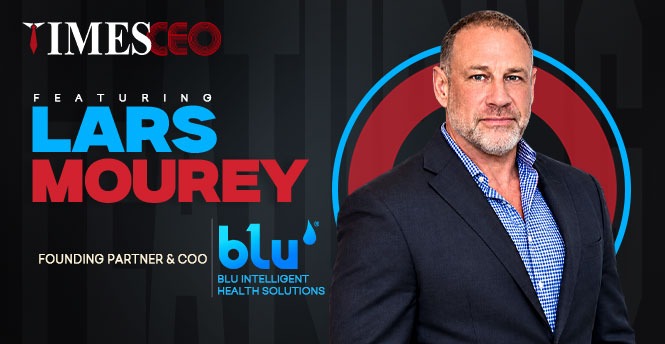
A Conversation with Lars Mourey
Sustainability in the hospitality industry requires more than introducing products designed to reduce resource consumption. For hotels and businesses, successful sustainability initiatives must deliver measurable benefits, maintain operational reliability, and meet customer expectations. Achieving this balance requires careful assessment, transparent communication, and a clear understanding of the needs of each property.
Lars Mourey, Founding Partner and Chief Operating Officer of Dubai-based blu Intelligent Health Solutions, approaches sustainability through these practical considerations. Alongside Ahmed Elgibaly, Founding Partner and Chief Executive Officer, Mourey has helped develop blu across consumer and hospitality markets, focusing on shower-water technology and solutions designed to address water efficiency and related customer needs.
The company’s approach reflects the importance of understanding property-specific requirements before making commercial projections. Water flow, pressure, guest experience, maintenance requirements, and operating costs all play a role in determining whether a proposed solution is suitable for a particular environment.
Beyond product development, Mourey emphasizes the importance of building reliable business processes, maintaining accurate product information, and ensuring that commercial commitments align with operational capabilities. These principles are particularly relevant as businesses explore sustainability initiatives while managing customer expectations and pursuing long-term growth.
In this interview, Mourey discusses how measurement can support credible sustainability proposals, why customer trust depends on clear communication, and how operational discipline, strategic partnerships, and responsible product claims contribute to building a sustainable business.
Assessing Water Efficiency Through Measurable Business Value
Times CEO Magazine: “What makes a water-efficiency proposal commercially credible for a hotel?”
Lars Mourey replied, “It starts with understanding the property rather than presenting a savings figure before we have assessed the conditions.
A hotel needs to know its existing shower flow rates, water pressure and equipment, as well as the requirements of its guests and engineering team. Occupancy, shower usage and the property’s water and energy costs are also relevant to the business case.
The next step is to consider what configuration may suit the property and, where appropriate, evaluate it through a trial. That allows the hotel to compare flow measurements and consider guest and operational feedback before deciding on a wider installation.
The financial calculation needs to be transparent. Reducing hot-water use can reduce the energy needed to heat that water, but the potential benefit depends on the property and the assumptions used. Installation, maintenance and replacement costs also belong in the assessment.”
Balancing Sustainability With Guest Experience
Times CEO Magazine: “How do you balance resource efficiency with guest experience?”
Lars Mourey replied, “A hotel should not have to make a decision based only on an attractive projection. The proposed solution also needs to work in the guest room and be manageable for the engineering team.
That is why pressure, spray experience, compatibility and maintenance matter alongside flow. A trial can help the hotel understand those factors in its own setting.
The right question is not simply, “Can we reduce water use?” It is, “Can we achieve a practical improvement for this property while delivering an experience appropriate for its guests?” The answer needs to be assessed property by property.”
Building a Sustainable Business Through Operational Discipline
Times CEO Magazine: “What have you learned about turning a product into a sustainable business?”
Lars Mourey replied, “A product is only one part of what a customer buys. Availability, accurate information, delivery and after-sales support all shape the experience.
In consumer retail and e-commerce, customers need to understand which product is suitable, how it fits and what maintenance it requires. In hospitality, the conversation also involves engineering teams, procurement and management, each with different questions.
As a business grows, it needs processes that connect those conversations. Sales should understand what operations can deliver, and customer support should be able to respond when a question arises after installation. The aim is to make the promises we make commercially consistent with the service we provide.”
Maintaining Transparency in Product and Sustainability Claims
Times CEO Magazine: “How do you manage product and sustainability claims?”
Lars Mourey replied, “I believe we should be precise about the function of each technology and the evidence behind a claim.
For example, filtration, softening and water efficiency address different needs. Our Ionic Shower Head & Filter uses an NMC filtration medium, while the NXT LVL Shower Softener & Filter uses ion-exchange resin intended to address hardness minerals. Those functions should not be treated as interchangeable.
We should also distinguish customer feedback from clinical evidence and property-specific estimates from guaranteed results. Being clear about limitations helps customers make better decisions and gives our teams a more dependable foundation for explaining the product.”
Expanding Through Strategic Partnerships
Times CEO Magazine: “What do you look for in a growth opportunity or partnership?”
Lars Mourey replied, “I want to understand the customer need, the responsibilities of each partner and how the customer will be supported after the first sale.
A partnership can create opportunities, but it also needs practical execution: product availability, customer education, distribution, service and a commercial structure that both sides understand. Those details matter as much as the initial ambition.
Our partnership with Pattern reflects our ambition to develop opportunities in Europe and North America. As with any expansion, progress depends on understanding the market and building the right support around the product.”
Measuring Growth Beyond Revenue
Times CEO Magazine: “How do you measure growth beyond revenue?”
Lars Mourey replied, “Revenue is important, but it does not tell the whole story. Profitability, service quality, customer satisfaction, repeat business and the reliability of operations all matter.
As COO, I see my responsibility as helping our teams work towards shared objectives while making sure we can deliver on our commitments. That means listening to customers and colleagues, reviewing where a process can improve, and addressing problems early.
For me, sustainable growth comes from building a business that customers and partners can rely on over time. Innovation creates the opportunity; consistent execution helps turn it into a lasting relationship.”
Building Long-Term Value Through Trust and Execution
As businesses across the hospitality and consumer sectors explore sustainability opportunities, the ability to demonstrate practical value remains essential. Solutions must be assessed in their intended settings, commercial projections must reflect realistic assumptions, and product claims must be supported by appropriate evidence.
Lars Mourey’s approach to building blu Intelligent Health Solutions highlights the connection between sustainability, customer experience, and operational performance. By emphasizing property-specific assessments, transparent communication, and dependable after-sales support, his perspective underscores the importance of aligning innovation with the practical requirements of customers and business partners.
The same principles extend to business development and international expansion. Strategic partnerships can open new markets, but lasting progress depends on clear responsibilities, reliable distribution, effective customer education, and consistent service delivery.
For Mourey, sustainable growth is not measured by revenue alone. Profitability, customer satisfaction, operational reliability, and repeat business are also important indicators of a company’s ability to create lasting value.
Ultimately, building a dependable business requires more than developing an innovative product. It demands a commitment to evidence-based communication, continuous improvement, and delivering on commercial promises. By bringing these priorities together, businesses can pursue sustainability while strengthening customer trust and establishing a foundation for long-term growth.
To Learn More:
blu Intelligent Health Solutions: https://www.bludubai.com/
blu Hospitality and Business Solutions: https://www.bludubai.com/pages/business
Lars Mourey on LinkedIn
Also Read:-
Alan Schwartz on FDA Standards and Global Regulatory Trends
Dr. Javad Nakhjavani on Engineering and Resilience
Mircea Craciun: Building a Sustainable European Business