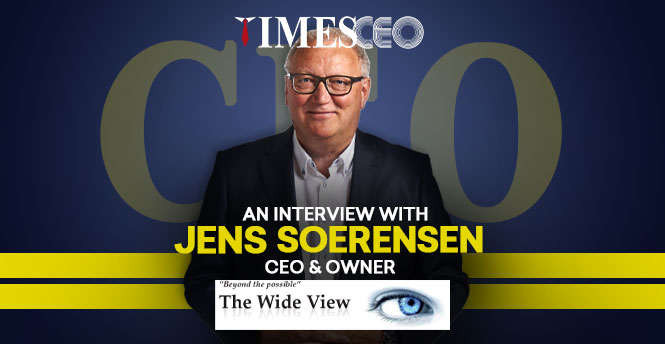
Jens Soerensen Interview
In an era defined by uncertainty, accelerated change, and relentless complexity, leadership is undergoing a profound transformation. Traditional playbooks no longer provide sufficient answers. Metrics alone fail to inspire. Execution without meaning collapses under sustained pressure. At the center of this shift stands a leadership philosophy that challenges conventional thinking and invites a broader, deeper understanding of what truly drives long term success: The Wide View. Beyond the Possible.
This in depth conversation with Jens Soerensen explores a leadership journey shaped by decades of senior executive responsibility, large scale industrial transformation, cross border integration, and strategic advisory at the highest level. It is a reflection on perspective, purpose, human centered leadership, creativity, and the future of industries facing fundamental reinvention, particularly within the automotive and industrial sectors.
Times CEO Magazine: The Wide View. Beyond the Possible. What does this philosophy truly mean in today’s complex business environment?
Jens Soerensen replied, “The Wide View is fundamentally about perspective. Many organizations become trapped in operational silos, short term KPIs, and inherited industry dogmas. Leaders focus on reacting faster, but gradually lose the ability to see further. Beyond the Possible means stepping back far enough to understand the entire system, including markets, people, culture, power dynamics, and the often invisible interdependencies that truly shape outcomes. In today’s environment, complexity is not the enemy; narrow thinking is. When leaders expand their viewpoint, they begin to recognize opportunities others overlook, new forms of collaboration, structural efficiencies, and sometimes entirely new business models. Strategy is not about speed alone. It is about clarity, foresight, and acting with intention.”
Times CEO Magazine: You often say that to become successful, you must first care about the soul of a company. Why is this so critical for long term success?
Jens Soerensen replied, “A company’s soul is its inner mechanism. It is formed by lived values, mutual trust, leadership integrity, and a shared sense of purpose. Financial results are not the starting point; they are the outcome. When leadership ignores the soul of the organization, performance may continue temporarily, but motivation weakens, decisions become defensive, and innovation fades. I have seen companies with excellent products fail because the internal culture was broken. At the same time, I have seen organizations overcome severe market challenges because people believed in the mission and trusted one another. Strategy without soul is mechanical. Strategy with soul becomes sustainable, scalable, and resilient.”
Times CEO Magazine: Your career spans senior executive roles, chairmanships, and now top level strategic advisory. How has your leadership perspective evolved over time?
Jens Soerensen replied, “In the early stages of my career, leadership was primarily about execution, structure, and discipline, particularly in large automotive and industrial environments. Those fundamentals remain important. Over time, however, I realized that the most powerful lever in leadership is not structure, but clarity. As a CEO, Chairman, and now as a strategic advisor, my focus has shifted from delivering answers to asking the right questions. True leadership is about enabling others to see clearly, think independently, and act responsibly. Authority may create compliance, but trust creates commitment, and commitment is what sustains organizations when pressure increases.”
Times CEO Magazine: You played a key role in large scale transformations, including Nordic expansion and cross border integration with Germany. What are the biggest challenges in strategic growth and M&A?
Jens Soerensen replied, “The biggest mistake in growth and M&A is overestimating spreadsheets and underestimating people. Synergies may look convincing on paper, but they do not automatically translate into operational reality. Cultural alignment, leadership chemistry, and decision governance are decisive factors. Successful M&A requires a clear strategic rationale, disciplined execution, and genuine respect for local identity. During the One House Philosophy within Hella’s aftermarket operations, the objective was unity without destroying entrepreneurial energy. Growth must feel meaningful to the organization. If it feels imposed from above, resistance inevitably follows.”
Times CEO Magazine: Beyond business, you have written books and released music albums. How do creativity and art influence your approach to strategy and leadership?
Jens Soerensen replied, “Creativity trains the mind to think in patterns, emotions, and flow, not only in logic. Music and writing sharpen intuition and empathy, both of which are essential leadership capabilities. Strategy is often presented as purely rational, but the most impactful decisions are made when logic and intuition work together. Art is a reminder that humans, not systems, create value. It keeps leaders grounded, curious, and open minded. Creativity is the ultimate strategic advantage, because it allows leaders to imagine futures that do not yet exist and then build them with intention.”
Times CEO Magazine: A final word after your many years within the automotive business?
Jens Soerensen replied, “The fire in business comes from intelligent people who think beyond normal standards, yet there are too few of them. The future demands a stronger brain flow to challenge outdated, copy driven approaches, particularly in traditional industries like automotive. There is no revolution in the word copy. To remain relevant and competitive, leaders must go beyond imitation, question established norms, and dare to rethink how business is done.”
For more insights, visit https://thewideview.dk/
Also Read:
Paul Robert Vogt, MD a Global Pioneer in Cardiac Surgery
CEO of Sapientia One Global Solutions, Dr. Alicia B. Harvey-Smith
Matteo Ciampica: Contemporary Art through Time