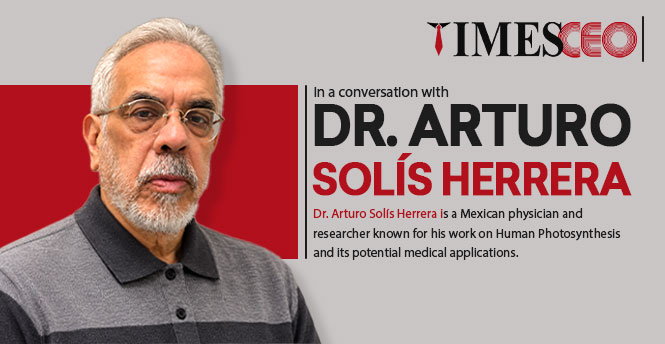
Dr. Arturo Solís Herrera Interview
Dr. Arturo Solís Herrera, MD, PhD, is the founding Director of the Human Photosynthesis Study Center in Aguascalientes, Mexico. His work focuses on research, development, and innovation related to melanin and its proposed role in energy transduction. According to his professional profile, his investigations began in 1990 and involved observational studies of nearly 6,000 patients, concluding in 2002. His research has explored the hypothesis that melanin may play a role in processes involving water and energy within the human body. The following interview questions explore his scientific journey, research methods, interest in melanin, and vision for future research.
Research Beginnings
We started the interview by asking, “Your research into human photosynthesis began with observations that developed over more than a decade. What first led you to investigate the role of melanin in the human body?”
Dr. Arturo Solís Herrera replied, “My interest developed through years of clinical observation and a desire to understand the biological functions of melanin beyond its traditionally recognized role in pigmentation and protection against ultraviolet radiation. I wanted to investigate whether this substance might have other important properties that could help us better understand the human body. In 1990, I began an observational study involving patients, carefully examining the patterns and questions that emerged during my work. Over the years, these observations encouraged me to look more closely at the relationship between melanin, water, and energy-related processes. The study continued until 2002 and involved nearly 6,000 patients, providing the foundation for the research direction I would pursue in the years that followed.
One of the central questions that emerged from my investigations concerned the possibility that melanin could participate in processes involving the dissociation and re-formation of water molecules. This led me to explore the hypothesis that melanin might have a role in energy transduction within biological systems. I realized that these questions deserved further investigation, both to understand the underlying mechanisms and to explore their potential scientific significance. This journey eventually led to the establishment of the Human Photosynthesis Study Center, where the focus is on research, development, and innovation in this field. For me, scientific discovery begins with asking questions that may not have obvious answers. However, I also believe that observations must lead to further investigation, careful testing, and independent verification. My aim has been to encourage a deeper examination of melanin and its possible functions, opening new avenues for scientific inquiry.”
Melanin and Energy
Times CEO: You have described melanin as having a potential role in converting light energy into chemical energy. What makes this area of research important to you?
Dr. Arturo Solís Herrera replied, “What interests me most is the possibility that melanin has biological properties that deserve closer scientific examination. Melanin interacts with light and has several recognized functions in living systems. My research has explored whether its interaction with light and water could have implications for energy-related processes in the human body. Understanding these mechanisms requires careful investigation, experimental validation, and a willingness to examine questions that may not yet have definitive answers.”
Lessons from Observation
Times CEO: Your observational research involved nearly 6,000 patients between 1990 and 2002. What did this experience teach you about conducting long-term scientific investigations?
Dr. Arturo Solís Herrera replied, “Long-term research teaches you the importance of patience, consistency, and careful observation. When a study spans many years, it is essential to document findings, compare observations, and continually evaluate the explanations being considered. My work over that period helped shape the questions I wanted to investigate further. It also reinforced my belief that scientific inquiry requires persistence, while conclusions must ultimately be supported by evidence that can be independently examined and reproduced.”
Educating for the Future
Times CEO: How can we accelerate the benefits of understanding the origin and sequence of life for humanity and the planet?
Dr. Arturo Solís Herrera replied, “I believe the most effective way to accelerate these benefits is by incorporating this knowledge into the educational curricula of all academic disciplines, beginning as early as elementary school. We need to encourage a broader understanding of how life works and how living organisms interact with energy and their environment.
One of the misconceptions I believe needs to be reconsidered is that only the leaves of plants can transform sunlight into chemical energy through the dissociation of water. My research on melanin and what I call human photosynthesis explores the possibility that this process extends beyond plants to humans, fish, and other living organisms.
Understanding this mechanism could fundamentally change how we approach biology, medicine, and environmental science. I believe that all living organisms have an intrinsic capacity to participate in oxygen production through processes occurring within their own biological systems, rather than depending exclusively on the oxygen available in their surroundings.
The sooner we introduce these concepts into education and scientific research, the sooner we can explore their potential benefits for human health and the planet.”
The Center’s Mission
Times CEO: You founded the Human Photosynthesis Study Center to advance research and development in this field. What is the center’s primary mission?
Dr. Arturo Solís Herrera replied, “The purpose of the Human Photosynthesis Study Center is to promote research, development, and innovation related to the properties of melanin and their possible applications. I wanted to establish a setting where these questions could receive sustained attention and where new research directions could be explored. The broader goal is to develop a better understanding of the biological processes under investigation and determine whether they can contribute meaningful knowledge to science. Progress in this area depends on systematic research, collaboration, and reliable evidence.”
Understanding Human Photosynthesis
Times CEO: The term “human photosynthesis” may sound unfamiliar to many people. How do you explain the concept to someone encountering your research for the first time?
Dr. Arturo Solís Herrera replied, “I explain human photosynthesis as a research concept centered on understanding the properties of melanin and investigating whether it plays a role in light-related energy processes within the human body. Most people are familiar with photosynthesis in plants, where light energy is used to convert water and carbon dioxide into chemical energy. Human biology is considerably different, so the term “human photosynthesis” should not be interpreted as suggesting that the human body performs the same process as a plant.
My interest lies in exploring what melanin can do beyond its widely recognized role in pigmentation and protection against ultraviolet radiation. Through my research, I have investigated the possibility that melanin interacts with light and water in ways that could have implications for biological energy processes. These questions encourage us to look more closely at the relationship between light, the molecules present in living systems, and the mechanisms that sustain biological activity. At the same time, it is important to distinguish a research hypothesis from an established scientific fact. Understanding whether these proposed mechanisms occur in the human body requires carefully designed experiments, reliable measurements, and independent scientific validation. For me, the purpose of using this term is to encourage further investigation into melanin’s properties and to explore questions that may help expand our understanding of human biology.”
Research Challenges
Times CEO: Research involving melanin, water dissociation, and energy conversion raises complex scientific questions. What challenges have you faced in investigating these mechanisms?
Dr. Arturo Solís Herrera replied, “One of the main challenges is that complex biological processes cannot be understood through observation alone. They require appropriate experimental methods, precise measurements, and explanations that can be tested by other researchers. Another challenge is communicating an unconventional research hypothesis in a way that encourages serious examination without getting ahead of the available evidence. I believe researchers must remain open to new possibilities while maintaining rigorous standards for demonstrating how a proposed mechanism works.”
Science through Collaboration
Times CEO: How do you see collaboration and independent scientific validation contributing to the future of human photosynthesis research?
Dr. Arturo Solís Herrera replied, “Collaboration is important because questions involving melanin, light, water, and energy cross several scientific disciplines. Researchers with expertise in biochemistry, biophysics, molecular biology, and related fields can bring different methods and perspectives to the investigation. Independent validation is equally important. If a proposed mechanism is supported by reproducible experiments, it becomes possible to understand its significance more clearly. I would like to see continued scientific examination of these questions and further work that clarifies which hypotheses can be supported by experimental evidence.”
A Vision for the Future
Lastly we asked, “Looking ahead, what are your priorities for the Human Photosynthesis Study Center, and what would you like future researchers to take forward from your work?”
“My priority is to continue encouraging research into the properties of melanin and the questions that initially motivated my work. I hope future researchers will examine these ideas with curiosity, technical expertise, and scientific discipline. They should be willing to investigate new possibilities while carefully distinguishing established findings from hypotheses that still require testing. Ultimately, the value of research lies in the knowledge it produces, the evidence it contributes, and its ability to help other scientists ask better questions and reach more reliable conclusions.” Dr. Arturo Solís Herrera concluded
Connect with Dr. Arturo Solís Herrera on Human photosynthesis
Also Read:-
Lars Mourey on Building blu Through Trust and Growth
Alan Schwartz on FDA Standards and Global Regulatory Trends
Dr. Javad Nakhjavani on Engineering and Resilience