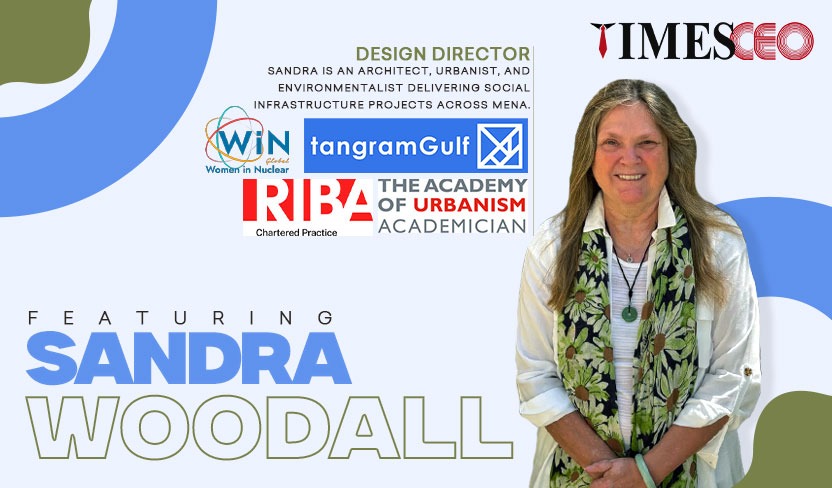
Sandra Woodall Interview
Sandra Woodall’s architectural journey is rooted in an understanding that buildings and cities are never isolated objects. They are living parts of communities, environments, cultures, and histories. With more than three decades of professional experience across the Gulf, Woodall has developed a distinctive approach to architecture and urbanism that brings together sustainability, heritage, climate responsiveness, and human wellbeing.
A Fellow of the Royal Institute of British Architects, the Royal Society of Arts, and the Academy of Urbanism, Woodall is Design Principal at tangram MENA and has played an active role in advancing sustainable design conversations across the Gulf. She is also the Chair of the Academy of Urbanism’s MENA Region Steering Group who has been involved in initiatives that encourage knowledge-sharing, mentorship, and greater awareness of climate-responsive architecture.
Her career has taken her from engineering and heritage infrastructure in the United Kingdom to some of the Gulf region’s most significant urban transformations. Along the way, she has developed a philosophy grounded in one central belief: architecture is about people, while sustainability is ultimately about life.
From Engineering and Heritage to Architecture
Times CEO: “Your journey began in engineering and heritage infrastructure before architecture. How did those early experiences shape your philosophy and approach to designing resilient and sustainable cities?”
Sandra Woodall replied, “My journey into architecture was shaped long before I formally studied it. I began my professional career in engineering, working on the refurbishment of the Rivington to Liverpool aqueduct, its water treatment works and service reservoirs. I was working with microfiche of drawings dating back to 1818, which gave me an extraordinary perspective on the longevity of infrastructure and the responsibility attached to creating systems that endure across generations.
“Following that, I worked on the regeneration of Liverpool’s Albert Dock, the UK’s largest collection of Grade I listed buildings. These projects taught me that the built environment is not just about constructing buildings. It is about stewardship, adaptation, and understanding that what we build today becomes part of a much longer human story.
“I became fascinated by how historic systems survived through change, evolved with communities, and remained relevant over time. That experience shaped my philosophy that architecture should never be designed merely for the present moment. It must anticipate future needs and create spaces that can evolve.
“Today, my approach remains rooted in that belief. Sustainability is not simply a technical exercise or a checklist. It is about creating environments that support people and communities while respecting environmental systems. True resilience comes from designing places that are flexible, culturally responsive, and capable of adapting to changing social and climatic conditions over many decades.”
Understanding the Complexity of Desert Urbanism
Times CEO: “Having spent more than three decades living and working across the Gulf region, how has your understanding of desert urbanism evolved?”
Sandra Woodall replied, “My arrival in the UAE was transformative both professionally and personally. I lived in Al Ain and was involved in reviewing and analysing a citywide master plan that covered an area approximately one third the size of Greater London.
“At that time, Al Ain was among the fastest changing cities on the Arabian Peninsula. It had evolved from a desert oasis comprising twelve scattered plantations and villages into a rapidly growing urban centre. During my arrival, the population had reached approximately one hundred thousand, and today it is approaching eight hundred thousand with expectations to exceed one million by the end of this decade.
“Experiencing that scale of transformation firsthand deeply influenced me. I realised that desert environments are often misunderstood as empty landscapes, when in reality they are highly sensitive ecosystems with unique climatic and cultural characteristics.
“Desert urbanism requires an entirely different way of thinking. It demands an understanding of climate, shading, thermal comfort, water management, materiality, and social behaviour. It also requires respect for traditional wisdom that evolved over centuries.
“This experience created a lifelong commitment within me to developing regionally grounded solutions that respond to local climate conditions while supporting long-term sustainability and resilience. I believe successful urban environments in the Gulf cannot simply replicate global models. They must emerge from local environmental and cultural realities.”
Where Heritage Meets Contemporary Development
Times CEO: “Throughout your career you have balanced heritage conservation with rapid modern development. How do you create that balance in your projects?”
Sandra Woodall replied, “One of the most valuable experiences in my career was working in Sharjah on the regeneration of the historic Al Murabba neighbourhood, the first stone town settlement on the banks of Sharjah Creek dating back to the mid nineteenth century.
“There I worked closely with archaeological advisers to understand traditional construction techniques and materials so they could be appropriately respected within contemporary redevelopment. I also delivered the Sharjah Art Museum, which was the only new building introduced into that restoration area.
“This experience taught me that heritage is not simply about preserving physical structures. It is about preserving identity, memory, and continuity.
“Later in Dubai, as Project Architect for the Etisalat Headquarters Tower, I then experienced a completely different environment, a rapidly expanding city moving at remarkable speed and scale. That period strengthened my technical resilience and ability to navigate complex projects in evolving regulatory contexts.
“Balancing heritage and modernity means understanding that progress does not require abandoning the past. The most meaningful projects are often those that create dialogue between historical understanding and future aspiration. Architecture should honour where communities come from while supporting where they are going.”
Making Sustainability Practical Through Design
Times CEO: “Sustainability has become central to your work and leadership. How have you seen sustainable design evolve across the Gulf region?”
Sandra Woodall replied, “The evolution has been remarkable. Around the early 2000s, my practice became increasingly committed to embedding passive sustainable design principles into every project through what is known as a Fabric First approach.
“In 2004, Dubai’s government appointed us to deliver a series of twelve community-based social infrastructure projects over seven years, including schools, healthcare facilities, government offices, and cultural centres integrated within expanding neighbourhoods.
“During those projects, we introduced climate-responsive strategies that were considered highly progressive at the time, though in fact followed the principles of traditional desert urbanism. These included green roofs irrigated with recycled grey water, reducing urban heat island effects, restoring biodiversity, improving air quality, and lowering the energy required to maintain internal comfort in extreme climates.
“What is fascinating is how many of these ideas later became part of broader regulatory frameworks. Dubai subsequently developed sustainable building codes and later introduced the Al Sa’fat rating system as a contextually relevant framework to evaluate environmental performance.
“Today, sustainability in the Gulf has moved beyond aspiration and into implementation. We now see requirements for low-carbon materials, renewable energy integration, water-efficiency measures, and wider environmental strategies.
“The conversation has evolved from asking whether sustainability matters to asking how we deliver it more effectively and at greater scale.”
Building a Culture of Sustainable Design Through Collaboration
Times CEO: “Through your work with the RIBA Gulf Sustainable Development Series and your wider leadership role, what message would you like to share with the next generation of architects and urbanists?”
Sandra Woodall replied, “In 2020 I co-founded the RIBA Gulf Chapter’s Sustainable Development Series because I believed that addressing climate challenges requires collaboration, shared knowledge, and continuous learning.
“Through webinars, workshops, district tours, panel discussions, and exhibitions, including our Sustainability Past, Present and Future exhibition showcased during COP28 in Dubai, we sought to empower designers across the region with practical knowledge and locally grounded solutions.
“For the next generation, my message is simple. Architecture is fundamentally about people and sustainability is about life. Buildings are not isolated objects. They shape how individuals live, interact, learn, heal, and connect.
“Future architects will face ever-growing challenges, including climate adaptation, resource pressures, population growth, growing AI and technological transformations, along with changing social needs. Addressing these challenges will require curiosity, humility, and interdisciplinary thinking.
“I encourage young professionals to remain rooted in context, understand local culture and environment deeply, and design intelligently with empathy. The most successful architecture is not necessarily the most visually iconic. It is architecture that improves lives, strengthens communities, and remains meaningful long into the future.”
A Regional Voice for Resilient and Contextual Architecture
Sandra Woodall’s career reflects the evolution of the Gulf itself, from rapidly developing urban centres to increasingly sophisticated conversations around climate, sustainability, identity, and resilience.
Her work demonstrates how lessons from heritage and traditional desert environments can inform contemporary architecture, while her leadership within the professional community continues to encourage collaboration and knowledge-sharing. Her involvement with the RIBA and the Academy of Urbanism, sustainable development initiatives, exhibitions, mentoring, and professional education has helped place context-driven sustainable design at the centre of regional architectural dialogue.
As cities across the Gulf continue to grow and confront the realities of climate change, resource pressures, technological transformation, and changing social expectations, Woodall’s philosophy offers a clear design principle: the future of architecture is not simply about building more. It is about building intelligently, responsibly, and with a deeper understanding of people and place.
For Sandra Woodall, architecture is ultimately a long-term commitment. It is about creating environments that can adapt, communities that can thrive, and places that retain meaning long after the architects who designed them have moved on.
Learn more about Tangram Gulf on their website
Connect with Sandra on LinkedIn
Also Read:-
MISPAYWAY Steps Up Regional Expansion
Mohammad Mousa: Driving Government & Business Transformation
Alaa Kamaz: Building a Business Empire with Vision & Innovation