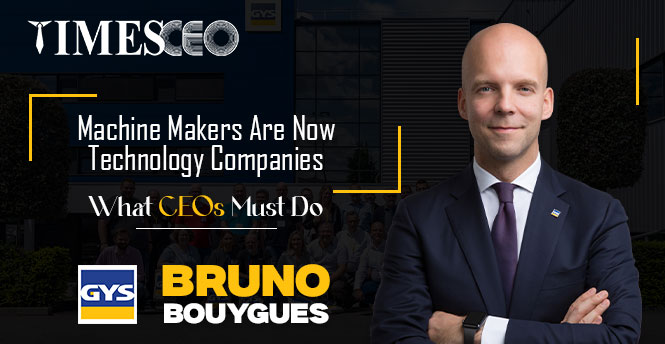
Machine manufacturers are becoming technology companies. Modern machines combine electronics, firmware, sensors, cybersecurity and AI, and they keep improving after installation. Bruno Bouygues, Chairman and CEO of GYS, a French manufacturer of machine tools, says leaders must therefore guide technology choices directly.
Is a modern machine still just hardware?
No. For most of the twentieth century, an industrial machine was an electromechanical assembly: steel, motors, gears and a control cabinet. Value came from precision, robustness and price. Today’s machines are something different. They are cyber-physical systems that combine power electronics, real-time firmware, connected sensors, cybersecurity and artificial intelligence.
For years, these disciplines lived in separate silos. The mechanical team designed the frame, the electronics team designed the boards, and software was added at the end. That model no longer works. The disciplines must now integrate seamlessly inside one product, from the first architecture decision.
The machine also does not stop evolving when it leaves the factory. After installation, it gains capabilities through software updates, generates data and plugs into broader customer ecosystems. The product a customer buys on day one is not the product they run two years later. That changes what customers expect, what competitors can copy and what a manufacturer must be good at.
What is physical AI, and why does it matter?
Physical AI is artificial intelligence embodied in physical systems, able to perceive and act on the real world. The technology industry increasingly uses the term. A system with physical AI does not only compute. It senses its environment, makes a decision and acts on it through hardware.
For machine manufacturers, this is no longer a distant horizon. It is already the ground on which differentiation is being built. A company that treats AI as a future add-on risks discovering that rivals have made it the core of their offering.
How does this change industrial production?
For a long time, leaders in INDUSTRIAL PRODUCTION measured excellence by two abilities: buying market share and hunting down the slightest cent of inefficiency in the factory. Both tools remain necessary. Neither is a sufficient shield.
The frontier of value has moved. It is no longer found only on the production lines. It now sits in the design offices, the laboratories and the teams that conceive tomorrow’s offering. A perfectly efficient factory that builds yesterday’s machine delivers little advantage.
Tomorrow’s equipment is a technology platform, and the hardware is only one part of its value. The rest comes from software, data and connected services. As a result, the boundary between machine manufacturer and technology company is becoming porous. A manufacturer that does not adapt to this reality will find itself competing on terms set by others.
What pressures do machine manufacturers face?
Three pressures stand out.
- Every added discipline increases the number of interfaces that can fail. One misstep in the software architecture, or in the selection of a critical component, can paralyze months of engineering.
- Global competitors, notably Asian ones, are able to model their iteration cycles on those of consumer tech. Commercial windows close faster than a traditional product cycle can follow.
- When a machine is largely software, it can become outdated sooner than its steel frame suggests. Customers compare it with what the best platforms can do today.
These pressures reinforce one another. Greater complexity slows development. Slower development meets shrinking market windows. The result is a company that is technically sound but commercially late.
What signal has the French State sent?
On July 10, 2026, the French State launched the “Défi Flagships” call for projects under France 2030. It aims to support innovative subsystems for robotics, drones and smart equipment. This public choice says something essential: French industrial competitiveness will no longer be determined by production volumes, but by companies’ ability to integrate electronics, software and embedded intelligence into their machines faster than their competitors.
In other words, the policy direction matches the market direction. Both reward companies that master the integration of these technologies, and both penalize those that rely only on scale.
Why must the CEO engage with technology?
Because the biggest decisions are technology decisions. Choosing a core architecture, deciding between in-house software and third-party components, or setting the balance between hardware and services all shape the company for a decade. They cannot be delegated entirely to a technical department and then simply approved.
This does not mean the CEO replaces the chief technology officer or reviews every line of code. It means the CEO, the executive committee and the business unit heads develop a technological understanding intimate enough to ask the uncomfortable questions, decide the major trade-offs and set investment priorities, in close cooperation with engineering teams.
What should CEOs ask their teams?
Four questions are a good starting point:
- What will our core technology building block be in five years? This forces a long-term view of where differentiation will come from.
- Should we develop software in-house or rely on third-party components? This decides who controls the pace of innovation and where the margin sits.
- Which architecture will scale our product range at the lowest cost? This addresses the technical debt that accumulates when every product is built differently.
- Will future margin come from hardware, software or connected services? This shapes investment, hiring and pricing.
These are executive-level choices, not technical details that can be isolated from the rest of the business.
Why should R&D be protected in a downturn?
In a context of shrinking markets, cutting engineering to save immediate operating profit is a deceptive reflex. It is not a saving. It is a deferred technological bankruptcy in the face of rivals who are accelerating. The leadership team must protect R&D efforts from short-term economic turbulence, because the products that sustain the company in three years are being designed now.
How should the organization adapt?
The mandate of the head of a machine manufacturer is changing in nature. It is no longer just to allocate capital, arbitrate budgets and control margins. It is to orchestrate the speed to market of highly complex solutions. Three practical moves follow:
- Break down silos. Bring mechanical engineers, electronics engineers, automation specialists and software developers into shared teams with shared goals.
- Simplify product architectures. Fewer platforms and fewer machine generations mean lower maintenance cost and faster launches.
- Give engineering culture a central place in the executive committee. Technology can no longer be treated as a support function.
In a sector where the machine is becoming software and obsolescence is accelerating, leadership teams that keep treating technology as a support function will not lose a battle. They will drop out of the game.
Connect Bruno Bouygues on LinkedIn
Visit GYS to get more information
Also Read:-
How to Start an Online Business From Home in 2026
10 Small Business Ideas With High Growth Potential in 2026
How Small Businesses Can Use AI for Customer Service