Giuseppe Giorgianni: The European AI Visionary Betting on Human-Centred Intelligence and the Future of Robotics
by Timesceo
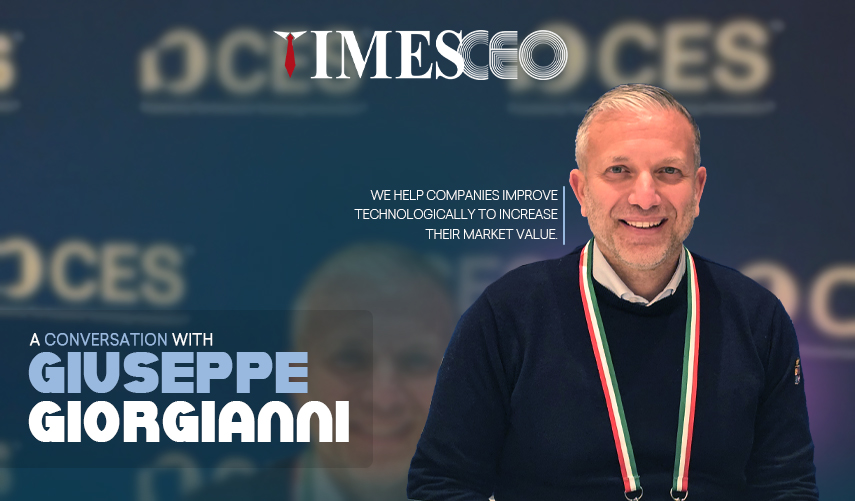
Giuseppe Giorgianni Interview
MILAN – Giuseppe Giorgianni arrives exactly on time, despite landing late the previous evening. At 50, the engineer once described by La Repubblica as “the Archimedes of Sicily” carries the composed intensity of someone used to operating across continents and time zones.
His schedule would exhaust most executives. Morning calls with developers. Afternoon meetings with partners in the UAE and China. Evening presentations for Italian industrial groups. Yet he appears energised rather than fatigued, especially when discussing what he is building next.
We meet just weeks after the World AI Cannes Festival, where Innovatech, the company Giorgianni founded and leads, introduced Kelly, its AI Digital Concierge, and unveiled a roadmap that surprised many observers: advanced perception systems for humanoid robotics.
“Everyone asks how powerful we can make AI,” he says, stirring an espresso. “I ask how useful we can make it. Those are two very different questions.”
That philosophy has shaped Innovatech into one of Europe’s most distinctive applied AI companies, focused not on spectacle but on systems that function reliably in real environments. While others chase headlines, Innovatech ships deployable solutions.
Forbes dedicated an episode of Forbes Revolution to Giorgianni’s work in telemedicine. At CES 2025, Innovatech’s Evolvera smartwatch, powered by fully customisable AI, was listed among the event’s top innovations. Yet outside specialist circles, Giorgianni remains relatively low profile.
Perhaps because his trajectory does not follow the standard technology script. There is no Silicon Valley mythology, no venture capital theatrics. Instead, there are decades spent building enterprise systems across multiple continents, learning how organisations truly operate and where technology genuinely creates value.
As the AI sector approaches an inevitable confrontation between hype and utility, Giorgianni’s emphasis on usefulness looks less contrarian and more prescient.
“AI Should Be Useful Before It Is Impressive”
Why do you emphasise usefulness over power?
Because power alone does not create value.
Technology is evolving faster than organisations and society can absorb it. The danger is building systems that are technically extraordinary but disconnected from real needs.
AI should simplify life. It should help people make better decisions, access services more easily, and work more effectively.
Innovation becomes meaningful only when it improves human experience.
The Birth of Effective Innovation
Giorgianni developed what he calls the Effective Innovation Method after observing a pattern across industries.
“Many innovation projects fail not because the technology is wrong,” he explains, “but because the problem they are trying to solve is unclear.”
The framework begins with people, not technology. It revolves around three questions:
- Does this solve a real problem?
- Does it create measurable value?
- Does it improve the experience of the people involved?
If the answer to any of these is no, it is not innovation. It is experimentation.
Refined through projects in healthcare, enterprise systems, and public administration, the methodology now forms the strategic backbone of Innovatech. Giorgianni is consolidating its principles into an upcoming book aimed at organisations navigating the AI transition.
“Innovation is not about adding more technology,” he says. “It is about removing unnecessary complexity. When innovation works, it becomes almost invisible.”
The Technology Ecosystem
Giorgianni opens his laptop. What appears is not a single flagship product but an integrated ecosystem of AI platforms, each designed to eliminate repetitive processes that consume time without generating value.
“Every solution we build targets activities that drain resources but do not contribute strategically,” he says.
Kelly – The AI Digital Concierge
Kelly exists in three vertical applications.
In tourism, it integrates with destination databases, event calendars, and booking systems. Early deployments have generated more than 30 percent higher engagement compared with traditional systems and a 25 percent increase in bookings.
In healthcare, Kelly understands hospital layouts, appointment systems, department locations, and visiting schedules. It guides patients through complex facilities while reducing staff time spent giving directions by up to 40 percent.
In retail environments, Kelly connects to inventory data, promotions, and customer service workflows, transforming front desks into multilingual digital assistance available around the clock.
Sofia – The AI HR Assistant
Sofia handles repetitive internal HR requests:
How many vacation days do I have?
What is the expense policy?
When is payroll processed?
The impact is measurable. Companies report a 40 percent reduction in repetitive HR queries and a 20 percent increase in employee satisfaction, freeing HR teams to focus on strategic priorities.
EVORA – Business Intelligence Reimagined
Traditional business intelligence platforms require technical specialists. EVORA removes that dependency.
Users ask questions in natural language and receive immediate answers, with full transparency regarding data sources.
“Business intelligence should empower decision makers, not just data scientists,” Giorgianni says.
Olivia – The Digital Caregiver
Connected to CheckMED, Innovatech’s patented telemedicine device, Olivia monitors vital signs in real time, triggers alerts when anomalies occur, and supports medication adherence.
“It is not another health app,” he explains. “It is a digital healthcare companion designed for everyday life.”
Why Human Names Matter
Each platform carries a human name: Kelly, Sofia, Olivia.
“It is intentional,” Giorgianni says. “You do not name a hammer. You name a colleague.”
The decision changes how people interact with technology. When employees say, “I will ask Sofia,” the psychological dynamic shifts. Adoption improves because the system feels collaborative rather than imposed.
A Contrarian Position in the AI Industry
Giorgianni believes the AI industry is dividing into two distinct paths.
On one side are frontier model developers pursuing artificial general intelligence, investing billions to expand technological boundaries. On the other are applied AI companies deploying existing capabilities to solve specific operational problems.
“We are not competing with OpenAI,” he says. “We are a customer. They build the engine. We build the car.”
He expects foundation models to become increasingly commoditised.
“The long term value is not in the model itself. It is in understanding which problem to solve and deploying solutions that actually work.”
He supports balanced regulation.
“Europe is right to regulate. But we must distinguish existential risks from operational friction. We need guardrails around dangerous AI, not bureaucracy around systems that answer HR questions.”
For Innovatech, transparency and explainability are not compliance exercises.
“Trustworthy AI is a design philosophy,” he says.
The Robotics Frontier
When the conversation turns to robotics, his energy visibly intensifies.
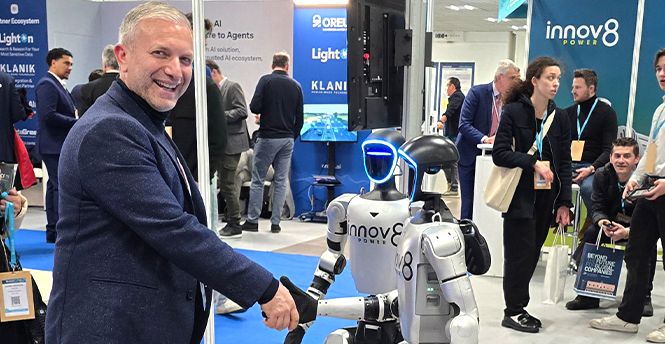
“Software AI has proven itself,” he says. “Kelly, Sofia, EVORA are deployed and generating value. The next wave is not just AI that thinks. It is AI that moves.”
Humanoid robotics is advancing rapidly. Improvements in decision making, sensors, and actuators are transforming what was experimental only a few years ago into emerging commercial reality.
Yet he identifies a critical bottleneck.
“The challenge is not mechanics anymore. It is perception.”
A robot that walks is impressive. A robot that understands what it sees changes everything.
Most robotic systems perform well in structured environments. Homes, offices, and logistics hubs are not structured. They are dynamic and unpredictable.
“At Innovatech, we are not building robots,” he says. “We are building the intelligence that makes robots useful.”
The company is developing advanced perception systems capable of interpreting space, understanding context, and reacting safely in real environments. Early stage pilots are focused on logistics, manufacturing, and domestic assistance, sectors with immediate economic relevance.
“This is not distant research,” he says. “We are targeting deployable systems within eighteen to twenty four months.”
The long term vision is platform based. Just as Lumetra AI powers multiple software applications, Innovatech’s perception systems are designed to integrate across different robotics manufacturers.
“If we execute correctly, our AI could power multiple robotics brands,” he says.
The Archimedes Parallel
The comparison to Archimedes resonates with Giorgianni for a reason.
“Archimedes was not interested in theory for its own sake,” he reflects. “He built machines that solved practical problems.”
Growing up in Sicily, he says, shaped his worldview.
“Sicily teaches adaptability. It teaches you to absorb influences from different cultures and transform them into something concrete. That is how we approach artificial intelligence.”
For Giorgianni, technology is not ideology. It is infrastructure. It is leverage. When designed properly, it fades into the background and allows people to perform at their best.

About Innovatech
Innovatech is a European technology company specialising in applied artificial intelligence for healthcare, enterprise systems, public administration, and robotics. Founded and led by engineer Giuseppe Giorgianni, the company operates across Italy, Bulgaria, and the UAE, serving enterprise organisations and smart city initiatives.
Core methodology: Effective Innovation, measurable value over technological novelty.
Contact: info@innovatech.info
Website: www.innovatech.info
Also Read:
Dr. Christoph Guger Leads BCI Spring School Innovation
Gayle Printz reshapes art with bold modern abstraction
Sofica Bistriceanu on Mental Balance & Relationship