Alexander Kopenkin, Founder of InTrouble: “The legal system of the UAE is closed to the majority of its residents. We are changing that.”
by Timesceo
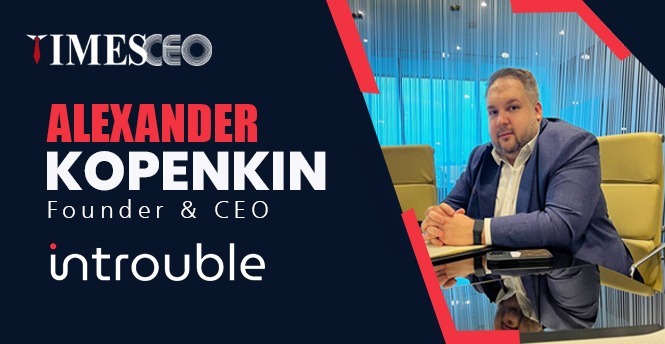
Alexander Kopenkin Interview
Alexander Kopenkin shares a powerful vision of using technology to solve systemic inequality in legal access. Through InTrouble, he is building an AI-driven legal ecosystem designed to make legal knowledge affordable, multilingual, and accessible to everyone in the UAE, especially underserved migrant communities. By combining innovation with social impact, his mission goes beyond business, aiming to create a scalable legal infrastructure that empowers individuals, supports businesses, and integrates with government systems for a more transparent and inclusive future.
Driven by Purpose, Not Profit
We started the interview by asking, “You are a serial entrepreneur and investor. What keeps driving you to build new ventures?”
Alexander Kopenkin replied, “It’s not business for its own sake it’s injustice that technology can fix. When I see millions of people cut off from something fundamental, not because it’s impossible to provide but simply because the system evolved that way that’s my signal. That’s how InTrouble was born. And that’s how we arrived at what we’re building now.”
Crisis Response to Systemic Solution
Times CEO Magazine: What inspired you to found InTrouble and where are you headed now?
Alexander Kopenkin replied, “InTrouble started as a crisis service: someone is in trouble, they need fast legal help. We handled acute situations detentions, travel bans, financial disputes. And in the process, we understood something important.
The problem isn’t just crisis situations. The problem runs much deeper: most people in the UAE simply don’t understand their rights. Not because they’re uneducated. But because the system is complex, it operates in Arabic or English, and a basic legal consultation costs around AED 3,000 while over 60% of migrants in the UAE earn less than AED 5,000 per month.
That means the legal system is effectively closed to the majority of people living here. They don’t know their rights as employees. They don’t understand what’s written in their contracts. They can’t figure out whether what’s happening to them is even legal. So they stay silent because there’s no one to ask and no money to pay.
That is the problem we’re now solving first.”
Building AI-Powered Legal Access
Times CEO Magazine: Tell us more, what exactly are you building?
Alexander Kopenkin replied, “We’re building an ecosystem of legal and advisory services powered by our own AI for every resident of the UAE, not just those who can afford a lawyer.
At the core of this ecosystem is InTrouble as the service, with ATLAS our own legal analytics engine as its intelligence layer. ATLAS is what makes InTrouble unique: it doesn’t just answer questions; it structures the situation, works through the facts, cites specific provisions of UAE law, and explains risks and options. All of that intelligence reaches the user through InTrouble in their native language, whether Arabic, Russian, Hindi, Urdu, or Tagalog 24 hours a day, 7 days a week.
A construction worker from Kerala who doesn’t know whether his employer is illegally withholding his salary he opens InTrouble and gets an answer. A waitress from the Philippines who doesn’t understand what’s written in her employment contract she finds out. An entrepreneur from Russia who doesn’t know what a bounced check means legally he knows what to do before the situation becomes a crisis.
This is not a replacement for a lawyer. It’s what should have existed a long time ago: an accessible entry point where a person understands their position in their own language, without having to pay thousands of dirhams upfront.”
Why the UAE, Why Now
Times CEO Magazine: Why does this matter now, and why the UAE specifically?
Alexander Kopenkin replied, “The UAE is one of the most multinational countries in the world. Around 90% of the population are expats. People arrive from dozens of countries, with different languages, different legal cultures, different expectations. And they enter a system that operates by its own rules strict, consistent, unforgiving of ignorance.
Meanwhile, access to legal information is staggeringly unequal. A large corporation hires a legal department. A wealthy expat hires a lawyer. But the taxi driver, the housekeeper, the mid-level manager they’re left alone with a system they don’t understand.
We think that’s unjust. And we think technology already makes it fixable.”
Scaling Impact
Times CEO Magazine: How does your background in venture capital and business shape this project?
Alexander Kopenkin replied, “Venture experience taught me one thing: real scale is always found where you solve a real problem for a real majority not an elegant problem for a wealthy minority. Premium legal services are a competitive market. Accessible legal tools for millions of people without a voice that’s an unoccupied niche and a social imperative at the same time.
My background in logistics and operational management gave me something else: the understanding that scale is not just technology. It’s a system. Properly built processes, the right legal partnerships, verified outputs. AI without structure is just noise. We’re not building a product. We’re building infrastructure.”
An Ecosystem of Clarity and Access
Times CEO Magazine: You also run Whale Solutions and Marchand Gallery. How do those fit with InTrouble’s mission?
Alexander Kopenkin replied, “On the surface, they look different. At the level of logic, they’re the same.
Whale Solutions helps individuals and businesses navigate the UAE: set up a company, relocate, understand regulations, find the right partners. It’s the same story about access to information and structure just for entrepreneurs.
Marchand is a different world the world of art. But there’s logic here too: art trains you to see what isn’t stated explicitly. In legal and business situations, the most important thing is often exactly what isn’t said out loud.
I’m not running a collection of unrelated projects. I’m building an ecosystem for people who need clarity in a complex environment.”
Understanding the System is Key
Times CEO Magazine: What advice would you give to anyone arriving in the UAE entrepreneurs and ordinary people alike?
Alexander Kopenkin replied, “The same advice, actually: learn the system before it surprises you. The UAE doesn’t forgive ignorance not because it’s harsh, but because it’s consistent. The rules work. And not knowing a rule doesn’t protect you from the consequences of breaking it.
Before, that meant: find a lawyer, pay the money, get a consultation. Now just open InTrouble in your own language at any hour. It doesn’t solve everything. But it gives you understanding. And understanding is already half the protection.”
A Vision for Legal Infrastructure
Lastly we asked, “Where do you see InTrouble in five years?”
“Three levels. Three segments. One infrastructure.
The first is where we started: individuals. Every resident of the UAE, regardless of income or language, should be able to understand their rights at any moment. That’s the foundation.
The second is the corporate segment. After large-scale testing, we’re moving into companies. For business, InTrouble means something concrete: reduced costs on routine legal consultations and relief for in-house lawyers from repetitive, basic tasks. A company’s lawyer should be handling strategic questions not explaining for the tenth time what’s written in an employee’s contract. That’s what InTrouble does, powered by ATLAS at its core.
The third is the government sector. Public service centers in the UAE are points through which millions of people pass. That’s exactly where a person comes face to face with the system, often without understanding their rights or obligations. We see our technology embedded in that infrastructure: as an accurate, multilingual, accessible source of legal information at the very moment a person interacts with the state.
These aren’t three separate businesses. It’s one platform operating at every level of society. We’re building the legal infrastructure of a country and I’m convinced that’s exactly what it should look like.” Alexander Kopenkin concluded
Connect with Alexander Kopenkin on LinkedIn
For more information visit InTrouble
Also Read:
Larry Kulchawik: Unveiling the Power of Trade Shows
Phoebe Tan: From Operational Precision to Circular Fashion
Giuseppe Giorgianni backs human-centred AI