How Can Businesses and Startups Use AI to Scale Faster?
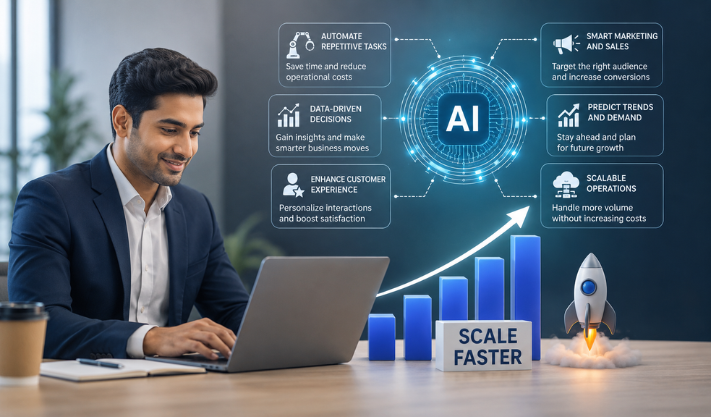
Artificial intelligence (AI) is changing how businesses and startups grow. Companies can use AI to automate repetitive tasks, understand customers, analyse data, improve decision-making, create content, optimise operations, and provide faster customer service.
For startups, AI can be especially valuable because small teams can accomplish tasks that previously required much larger departments. Established companies can also use AI to increase productivity, reduce operating costs, improve customer experiences, and develop new products and services.
But how can businesses and startups actually use AI to scale faster? The answer starts with choosing the right AI use cases, preparing quality data, training employees, and integrating AI into everyday business processes.
What Does AI-Powered Business Scaling Mean?
AI-powered business scaling means using artificial intelligence to increase a company’s capacity without increasing costs and resources at the same rate.
For example, instead of hiring additional employees to answer every new customer query, a company can use AI-powered customer support to handle common questions automatically. AI can also help automate data analysis, marketing, document processing, sales research, and administrative tasks.
The goal is not to use AI simply because it is popular. Businesses should identify areas where AI can deliver measurable improvements in productivity, efficiency, revenue, or customer satisfaction.
How Can Startups Use AI to Scale Faster?
Startups can use AI to automate repetitive work and allow smaller teams to accomplish more.
AI can support startups with:
- Customer support
- Marketing and content creation
- Sales research
- Data analysis
- Product development
- Market research
- Administrative tasks
- Financial forecasting
- Recruitment
- Customer personalisation
For startups with limited resources, automation can reduce manual work and operating costs.
This allows founders and employees to spend more time on strategy, product development, customer relationships, innovation, and business growth.
How Can Businesses Automate Processes With AI?
Automating repetitive workflows is one of the most practical ways businesses can benefit from AI.
Companies can use AI to process documents, categorise information, generate reports, organise emails, extract data, schedule tasks, and handle routine customer requests.
For example, an AI system can extract information from invoices and transfer relevant data into accounting software. An AI customer service system can answer common questions and send complex issues to human agents.
This type of automation saves time and allows employees to focus on higher-value work.
How Can AI Improve Customer Service?
AI can help businesses provide faster, more consistent, and personalised customer service.
AI-powered chatbots and virtual assistants can answer frequently asked questions, provide product information, track orders, schedule appointments, and guide customers through simple processes.
Businesses can also use AI to analyse customer conversations and identify recurring problems.
However, human support remains important for complex, sensitive, or unusual customer issues. The most effective approach is often a combination of AI automation and human expertise.
How Can AI Help Businesses Increase Sales?
AI can support sales teams by helping them identify potential customers, evaluate leads, personalise communication, and forecast sales.
Businesses can use AI for:
- Lead research
- Lead prioritisation
- Personalised email creation
- Customer interaction analysis
- Sales forecasting
- Upselling opportunities
- Follow-up automation
AI can reduce the time sales professionals spend on repetitive research and administrative work.
This allows sales teams to focus more on building relationships, understanding customer needs, and closing valuable opportunities.
How Can Startups Use AI for Marketing?
Marketing is another area where businesses can benefit from AI without building a large marketing department.
Generative AI can assist with first drafts of blog posts, social media content, email campaigns, product descriptions, advertising concepts, and other marketing materials.
AI can also analyse customer behaviour and marketing performance to identify trends and opportunities.
However, businesses should not rely entirely on AI-generated content. Human review is essential for accuracy, originality, brand voice, expertise, and credibility.
How Can AI Help Businesses Analyse Data?
Modern businesses generate huge amounts of data through websites, sales platforms, customer transactions, financial systems, and other digital tools.
AI can analyse this information much faster than traditional manual methods.
Businesses can use AI to identify:
- Customer trends
- Sales patterns
- Operational problems
- Market opportunities
- Revenue trends
- Customer preferences
- Business risks
Better data analysis can help business leaders make faster and more informed decisions.
How Can AI Increase Employee Productivity?
AI can work as a digital assistant that supports employees with everyday tasks.
Employees can use AI to summarise documents, draft emails, analyse information, create presentations, organise notes, generate reports, and research topics.
This can reduce the amount of time employees spend on administrative work.
The greatest productivity gains often come when AI is integrated directly into existing workflows rather than being used as a separate or standalone tool.
Can Startups Use AI to Develop Products Faster?
Yes. AI can support several stages of product development.
Technology startups can use AI for coding assistance, software testing, research, data analysis, design concepts, documentation, and customer feedback analysis.
AI can help development teams move from an initial idea to a prototype more quickly.
However, AI-generated code, designs, and recommendations still require human testing and review. Businesses should not sacrifice security, quality, or reliability simply to increase development speed.
How Can AI Help Businesses Reduce Costs?
AI can help reduce business costs by automating repetitive processes, improving efficiency, reducing errors, and helping companies use resources more effectively.
For example, predictive analytics can help businesses forecast demand and avoid unnecessary inventory. AI-powered automation can reduce manual data entry, while intelligent customer support can handle routine questions.
The strongest AI investments are generally those that solve clear business problems and produce measurable results.
How Can AI Improve Customer Personalisation?
Customers increasingly expect businesses to provide relevant and personalised experiences.
AI can analyse customer behaviour, preferences, purchase history, and previous interactions to help businesses personalise recommendations and communication.
For example, e-commerce businesses can use AI to recommend relevant products, while marketing teams can use customer data to create more targeted campaigns.
Personalisation can improve customer engagement when it is based on useful data and managed responsibly.
How Does AI Support Business Decision-Making?
AI can help business leaders analyse large datasets and identify patterns that may be difficult to detect manually.
Businesses can use AI for forecasting, risk analysis, pricing, market research, financial planning, and operational optimisation.
However, AI should support business decisions rather than replace human judgement completely.
Leaders should understand the limitations of AI systems and verify important recommendations before making critical decisions.
How Can Small Businesses Start Using AI?
Small businesses do not need to build their own AI models to benefit from artificial intelligence.
They can begin with simple, high-value applications such as:
- Customer service automation
- Marketing automation
- Document processing
- Data analysis
- Scheduling
- Content assistance
- Internal knowledge management
A practical approach is to identify repetitive tasks that consume significant employee time and determine whether AI can safely automate or accelerate them.
Starting with one or two use cases allows businesses to measure results before expanding AI across the organisation.
What Are the Biggest Challenges of Using AI for Business Growth?
AI can create major opportunities, but businesses also need to manage its risks.
Common challenges include:
- Data privacy
- Cybersecurity
- Poor-quality data
- AI errors
- Employee training
- Integration with existing systems
- Regulatory requirements
- Lack of AI expertise
- Over-reliance on automation
Companies should create clear policies for responsible AI use and maintain human oversight for important business decisions.
How Can Companies Prepare for an AI-Driven Future?
Businesses can prepare for an AI-driven future by developing a clear AI strategy connected to their actual business goals.
A strong approach includes identifying valuable use cases, improving data quality, selecting appropriate AI technologies, training employees, protecting sensitive information, and measuring results.
Companies should also regularly evaluate AI systems to make sure they remain accurate, secure, reliable, and aligned with business objectives.
The most successful AI adoption strategies combine technology with human expertise.
What Is the Future of AI for Businesses and Startups?
AI is likely to become increasingly integrated into everyday business operations.
Artificial intelligence will continue to appear in customer service platforms, marketing systems, financial software, enterprise applications, development tools, sales processes, and business analytics.
For startups, AI can make it possible to develop products with smaller teams and reach customers more efficiently.
For established businesses, AI can create opportunities to modernise operations, improve productivity, and develop new revenue streams.
Businesses that treat AI as a long-term capability rather than a short-term trend are more likely to gain sustainable value from the technology.
FAQs
How can AI help a business grow faster?
AI can automate repetitive processes, improve customer service, analyse data, support sales and marketing, and increase employee productivity.
Is AI useful for small businesses?
Yes. Small businesses can use AI for customer support, content creation, marketing, data analysis, administration, and workflow automation.
Can AI reduce business costs?
Yes. AI can reduce costs by automating manual work, improving productivity, reducing errors, and helping businesses use resources more efficiently.
Will AI replace employees?
AI is more commonly used to automate specific tasks rather than replace entire job roles. It can help employees work faster and focus on higher-value responsibilities.
How can startups use AI for growth?
Startups can use AI for product development, customer support, sales, marketing, market research, data analysis, and operational automation.
What is the best way to start using AI?
Start with one or two repetitive and measurable business processes where AI can provide clear value. Measure the results before expanding AI to other areas.
What skills do employees need for AI?
Employees increasingly need AI literacy, data analysis, critical thinking, digital skills, cybersecurity awareness, and the ability to work effectively with AI tools.
Conclusion
AI gives businesses and startups a powerful way to scale faster, improve productivity, reduce repetitive work, and create better customer experiences.
The biggest opportunities are in automation, customer service, marketing, sales, data analysis, product development, and business operations.
However, successful AI adoption is not simply about choosing the latest AI technology. Businesses need clear objectives, quality data, skilled employees, strong cybersecurity, responsible AI policies, and continuous performance measurement.
The future of business growth will increasingly involve people and AI working together. Startups and established organisations that integrate AI strategically can increase their capacity, respond to customers faster, improve efficiency, and create new opportunities for sustainable growth.
Also Read:-
How Can Entrepreneurs Grow Successful Skincare Business Now?
Who Are the Top 10 Real Estate Companies?
What Are the Best Ways to Make Money Online?