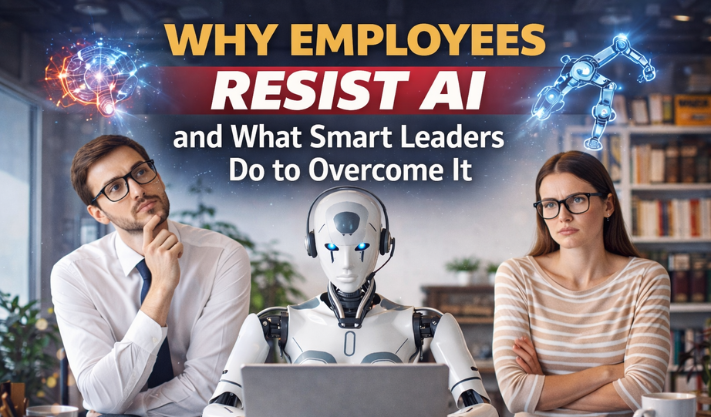
Why Employees Resist AI and What Smart Leaders Do to Overcome It
Artificial Intelligence (AI) is transforming workplaces across industries. From automating repetitive tasks and analyzing massive datasets to improving customer service and enhancing decision-making, AI promises significant benefits for organizations. Yet despite its growing adoption, many employees remain skeptical or resistant to AI initiatives.
For business leaders, this resistance can become a major obstacle to digital transformation. While technology itself may be powerful, successful AI implementation ultimately depends on people. Understanding why employees resist AI—and how effective leaders address those concerns—is essential for organizations seeking long-term success.
The Growing Presence of AI in the Workplace
Over the past few years, AI has moved from a futuristic concept to a practical business tool. Companies now use AI for everything from recruitment and marketing to finance, logistics, and customer support.
Organizations are investing heavily in AI because it can increase efficiency, reduce operational costs, and uncover insights that humans might overlook. However, employees often view these changes through a different lens. Instead of seeing opportunity, they may see uncertainty, disruption, or even a threat to their careers.
This gap in perception is one of the primary reasons AI adoption faces resistance.
Why Employees Resist AI
1. Fear of Job Loss
The most common concern employees have about AI is the fear of being replaced.
When workers hear about automation, they often assume their jobs may become obsolete. Employees worry that machines will eventually perform tasks faster, cheaper, and more accurately than humans.
Even when organizations insist that AI is designed to assist rather than replace employees, many workers remain cautious. Uncertainty about future job security naturally creates resistance.
2. Lack of Understanding
Many employees do not fully understand how AI works or how it will affect their daily responsibilities.
Without proper education, people often rely on assumptions influenced by media headlines, science fiction, or workplace rumors. This can lead to misconceptions about AI’s capabilities and intentions.
When employees lack accurate information, fear tends to fill the gap.
3. Fear of Change
Human beings are naturally resistant to significant change. New technologies often require employees to learn unfamiliar skills, adopt new processes, and alter established workflows.
For many workers, especially those who have spent years mastering existing systems, these changes can feel overwhelming.
Resistance is often less about AI itself and more about discomfort with uncertainty and disruption.
4. Concerns About Skills and Competence
AI adoption frequently requires employees to develop new technical skills.
Some workers worry they may struggle to keep up with changing workplace demands. Others fear that younger or more tech-savvy colleagues will adapt more quickly, potentially putting their own careers at risk.
These concerns can create anxiety and reduce enthusiasm for AI initiatives.
5. Trust and Transparency Issues
Employees may question how AI systems make decisions.
For example, if AI influences hiring, performance evaluations, scheduling, or promotions, workers may wonder whether the technology is fair, accurate, or unbiased.
A lack of transparency can lead employees to distrust both the technology and the leadership implementing it.
6. Loss of Human Connection
Many employees value the human aspects of their work, including collaboration, creativity, and personal interaction.
When organizations emphasize automation, workers may fear that workplace relationships and human judgment will become less important.
This concern is particularly common in customer-facing roles where empathy and communication are essential.
The Cost of Ignoring Employee Resistance
Some leaders make the mistake of focusing exclusively on technology while overlooking employee concerns.
This approach often leads to:
- Reduced productivity
- Lower employee morale
- Increased turnover
- Poor adoption rates
- Failed digital transformation projects
Even the most advanced AI systems can deliver disappointing results if employees refuse to use them or actively resist implementation efforts.
Organizations that ignore resistance often discover that technology alone cannot drive meaningful change.
What Smart Leaders Do Differently
Successful leaders understand that AI adoption is not merely a technology project—it is a people project.
Here are the strategies smart leaders use to overcome employee resistance.
1. Communicate Early and Often
One of the biggest mistakes leaders make is waiting too long to discuss AI initiatives.
Employees should hear about upcoming changes directly from leadership rather than through rumors or speculation.
Effective leaders clearly explain:
- Why AI is being introduced
- What problems it will solve
- How it will impact employees
- What benefits workers can expect
Open communication reduces uncertainty and builds trust.
2. Focus on Augmentation, Not Replacement
Smart leaders emphasize that AI is designed to enhance human capabilities rather than eliminate them.
Instead of presenting AI as a replacement for employees, they position it as a tool that removes repetitive tasks and allows workers to focus on higher-value activities.
When employees see AI as a partner rather than a competitor, resistance often decreases significantly.
3. Invest in Training and Upskilling
Education is one of the most effective ways to reduce fear.
Leaders should provide training programs that help employees understand:
- Basic AI concepts
- How AI tools work
- How AI will affect their roles
- New skills needed for future success
Upskilling initiatives demonstrate that the organization is investing in its workforce rather than replacing it.
4. Involve Employees in the Process
People are more likely to support changes they help create.
Successful organizations involve employees in AI planning, testing, and implementation. Gathering employee feedback not only improves adoption but also helps identify practical concerns that leadership may overlook.
Participation creates a sense of ownership and reduces resistance.
5. Address Ethical Concerns Transparently
AI raises legitimate questions about privacy, fairness, and decision-making.
Smart leaders openly discuss how AI systems are developed, monitored, and governed. They establish clear policies regarding data usage, accountability, and ethical standards.
Transparency helps employees feel more confident in the organization’s intentions.
6. Celebrate Early Successes
Nothing builds confidence like visible results.
Leaders should highlight examples where AI has helped employees save time, improve performance, or eliminate tedious work.
Sharing success stories demonstrates the practical benefits of AI and encourages broader adoption across the organization.
7. Build a Culture of Continuous Learning
AI technology evolves rapidly. Organizations that thrive in the AI era create cultures where learning is ongoing rather than occasional.
Employees should feel encouraged to experiment, develop new skills, and adapt to emerging technologies without fear of failure.
A learning-oriented culture reduces anxiety and increases resilience during periods of change.
The Human Side of AI Transformation
One of the most important lessons for leaders is that AI transformation is fundamentally about people.
Technology can automate tasks, analyze data, and optimize processes, but it cannot replace human creativity, empathy, judgment, and leadership.
The most successful organizations recognize that AI and human talent work best together. Rather than viewing AI as a substitute for employees, they use it to empower workers and enhance their capabilities.
When employees understand this vision, resistance often turns into curiosity, engagement, and innovation.
Looking Ahead
As AI becomes increasingly integrated into workplaces, employee concerns will continue to evolve. Organizations that proactively address these concerns will gain a significant competitive advantage.
Leaders who prioritize communication, education, transparency, and employee involvement are far more likely to achieve successful AI adoption.
The future of work is not about humans versus machines. It is about humans and machines working together to achieve better outcomes.
Conclusion
Employee resistance to AI is not a sign of failure—it is a natural response to uncertainty and change. Workers want reassurance that their skills, careers, and contributions will remain valuable in an increasingly automated world.
Smart leaders recognize these concerns and address them directly. Through clear communication, training, transparency, and employee engagement, they transform fear into confidence and resistance into support.
Organizations that successfully combine technological innovation with human-centered leadership will be best positioned to thrive in the age of AI.
Also Read:-
How CEOs Can Boost Mental Fitness for Better Leadership
In Industry, the Real AI Battle Isn’t the One You Think By Bruno
Why Successful CEOs Still Struggle to Scale Their Businesses