15 Powerful Leadership Strategies to Inspire Accountability and Ownership
Accountability and ownership are the backbone of high-performing teams. Without them, even the most talented groups struggle with missed deadlines, unclear responsibility, and declining morale. Strong leadership is not about controlling every detail—it’s about creating an environment where people naturally take responsibility for outcomes and feel personally invested in success.
Great leaders don’t just assign tasks; they cultivate mindset shifts. They help individuals move from “this is what I was told to do” to “this is what I am responsible for making successful.” The following 15 leadership strategies are designed to build that culture of accountability and ownership in any organization.
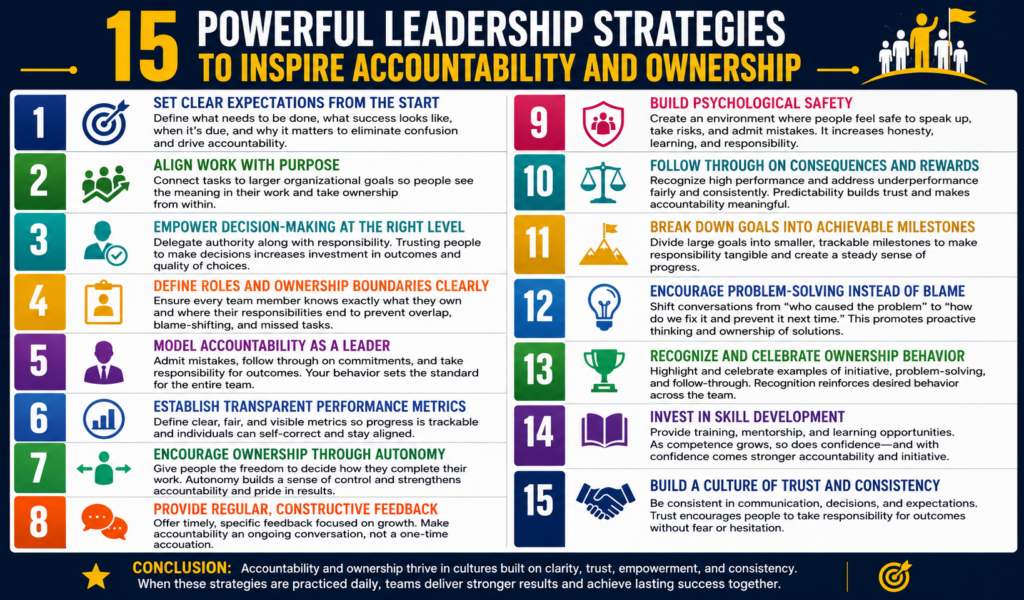
1. Set Clear Expectations from the Start
Accountability begins with clarity. Leaders must define not only what needs to be done but also what success looks like, when it is due, and why it matters. Vague instructions lead to inconsistent outcomes. When expectations are precise and measurable, team members can take ownership without confusion.
2. Align Work with Purpose
People are more likely to take ownership when they understand the purpose behind their work. Leaders should consistently connect tasks to larger organizational goals. When employees see how their efforts contribute to a meaningful mission, accountability becomes self-driven rather than enforced.
3. Empower Decision-Making at the Right Level
Micromanagement kills ownership. Instead, leaders should delegate decision-making authority along with responsibility. When individuals are trusted to make choices within their scope, they naturally become more invested in outcomes and more careful about the quality of their decisions.
4. Define Roles and Ownership Boundaries Clearly
Ambiguity is one of the biggest barriers to accountability. Every team member should know exactly what they own and where their responsibilities end. Clear ownership boundaries prevent overlap, reduce blame-shifting, and ensure that nothing falls through the cracks.
5. Model Accountability as a Leader
Leadership behavior sets the tone for the entire team. When leaders admit mistakes, follow through on commitments, and take responsibility for outcomes, they create a culture where accountability is normal rather than feared. Teams mirror what they observe in leadership behavior.
6. Establish Transparent Performance Metrics
What gets measured gets managed. Leaders should define transparent, fair, and visible performance indicators. When progress is trackable, individuals can self-correct and stay aligned with expectations without constant supervision.
7. Encourage Ownership Through Autonomy
Autonomy is a powerful motivator. When people have the freedom to decide how they complete their work, they begin to see results as a reflection of their own decisions. This sense of control strengthens both accountability and pride in outcomes.
8. Provide Regular, Constructive Feedback
Feedback should be timely, specific, and focused on growth. Leaders must avoid waiting for annual reviews to address issues. Continuous feedback helps individuals stay aligned and reinforces a culture where accountability is an ongoing conversation, not a one-time judgment.
9. Build Psychological Safety
People only take ownership when they feel safe to speak up, take risks, and admit mistakes. Leaders must create an environment where failures are treated as learning opportunities rather than reasons for punishment. Psychological safety increases honesty and responsibility.
10. Follow Through on Consequences and Rewards
Accountability requires consistency. Leaders must recognize high performance and address underperformance fairly and consistently. When consequences and rewards are applied predictably, trust in the system grows and ownership becomes more meaningful.
11. Break Down Goals into Achievable Milestones
Large goals can feel overwhelming and reduce ownership. Leaders should divide objectives into smaller, trackable milestones. This makes responsibility more tangible and helps individuals feel a steady sense of progress and control over outcomes.
12. Encourage Problem-Solving Instead of Blame
A blame-focused environment destroys accountability. Leaders should redirect conversations from “who caused the problem” to “how do we fix it and prevent it next time.” This shift encourages proactive thinking and strengthens responsibility for solutions.
13. Recognize and Celebrate Ownership Behavior
Positive reinforcement matters. When leaders highlight examples of strong ownership—such as initiative, problem-solving, or follow-through—it reinforces desired behavior across the team. Recognition builds a culture where accountability is valued and repeated.
14. Invest in Skill Development
People cannot take full ownership if they lack the skills to succeed. Leaders must invest in training, mentorship, and continuous learning. As competence grows, so does confidence—and with confidence comes stronger accountability and initiative.
15. Build a Culture of Trust and Consistency
At the core of accountability is trust. Leaders must be consistent in their communication, decisions, and expectations. When teams trust leadership, they are more willing to take responsibility for outcomes without fear or hesitation. Consistency reinforces reliability across the organization.
Conclusion
Inspiring accountability and ownership is not about tightening control—it is about expanding trust, clarity, and empowerment. Effective leaders create systems where responsibility is clearly defined, progress is measurable, and individuals feel both capable and supported.
When these 15 strategies are applied consistently, teams shift from passive task execution to active ownership. The result is stronger performance, higher engagement, and a culture where accountability is not enforced but embraced.
Also Read:-
Why Your Biggest Leadership Blind Spot Is Not What You Expect
Top 15 UK CEOs Revolutionizing Global Business in 2026
When Leaders Choose People Over the Organization, Everyone Loses